Customers → Personal data (the personal data module) does three jobs: it holds counters and advertising code back until a visitor agrees, it records every consent, and it answers a customer who asks what the shop keeps about them or wants it erased.
Settings
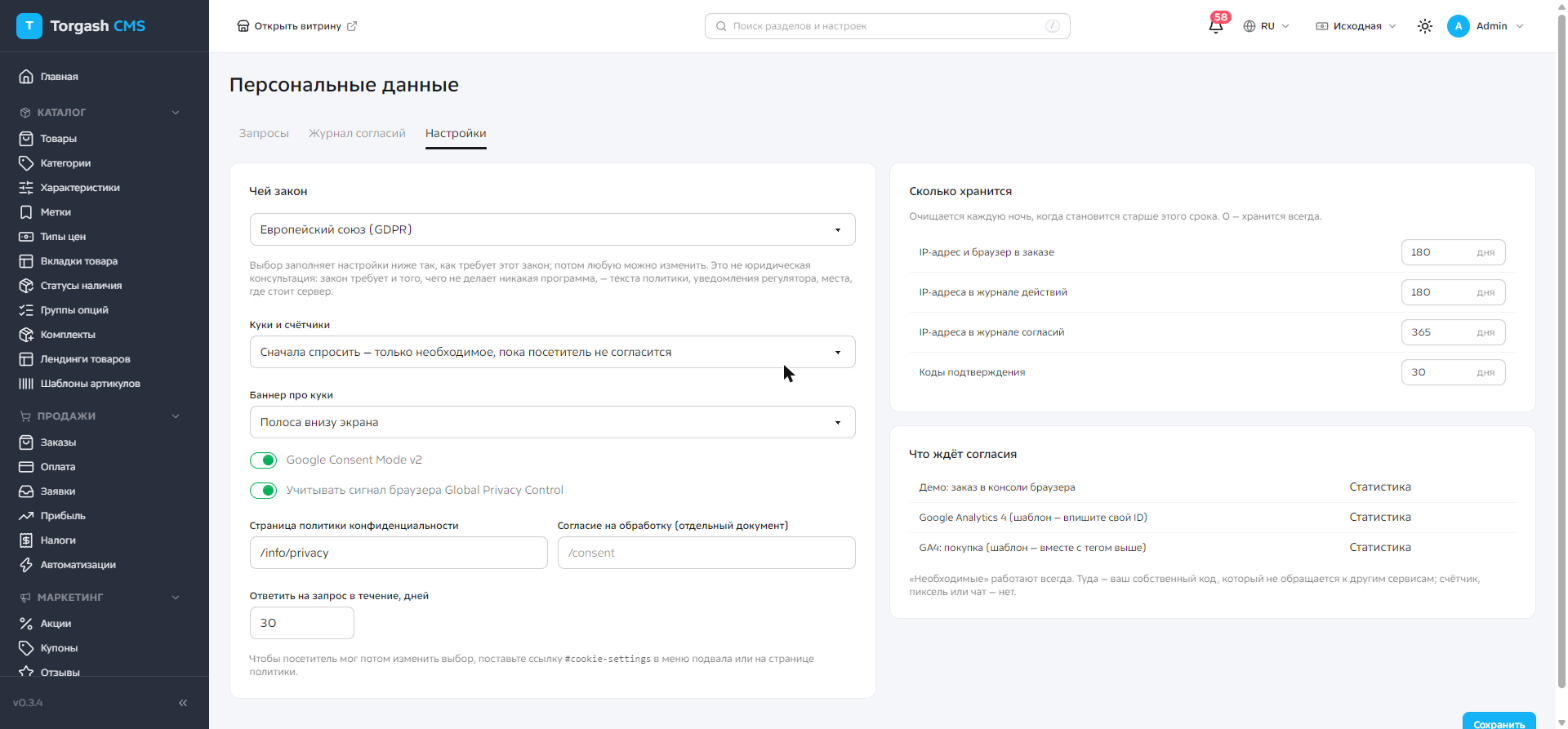
Whose law fills in the rest the way that law asks. Change anything afterwards and press Save.
| Law | Cookies and counters | Answer a request within |
|---|---|---|
| European Union (GDPR) | ask first | 30 days |
| United States (CCPA and the like) | allowed until refused; the browser’s privacy signal holds ads back | 45 days |
| Russia (152-FZ) | ask first; link a separate consent document | 14 days |
| Ukraine | ask first | 30 days |
- Cookies and counters — ask first, allowed until refused, or do not ask at all.
- The cookie banner — a bar at the bottom of the screen or a card in the corner.
- Google Consent Mode v2 — passes the visitor’s choice to Google’s tags.
- Honour the browser’s Global Privacy Control — a browser’s “do not sell my data” signal holds advertising code back, as a refusal.
- Privacy policy page and Consent to processing — the pages the banner and the forms link to.
To let visitors change their mind later, put a link to #cookie-settings in the footer menu or on the policy page.
Counters, pixels, chats
Everything from another service goes in through Marketing → Code snippets, and each snippet has a category:
- Necessary — runs always. Your own code that talks to no other service.
- Functional — a support chat, maps, a reviews widget.
- Statistics — Google Analytics, Yandex Metrica, Hotjar.
- Marketing — Facebook, TikTok, Google Ads pixels.
Until the visitor agrees, a snippet of that category sits on the page doing nothing. The moment they press “Accept”, it runs on the same page, without a reload. What waits for consent on the settings screen lists your snippets and warns when the addresses in one look like statistics or advertising but it is marked necessary.
The consent log
The Consent log tab holds every “I agree” given on the site, in the cookie banner and in forms: who, when, to what and where, with the words it was given under. That is what shows a consent was really given. Search by email, phone or IP address.
Customers’ requests
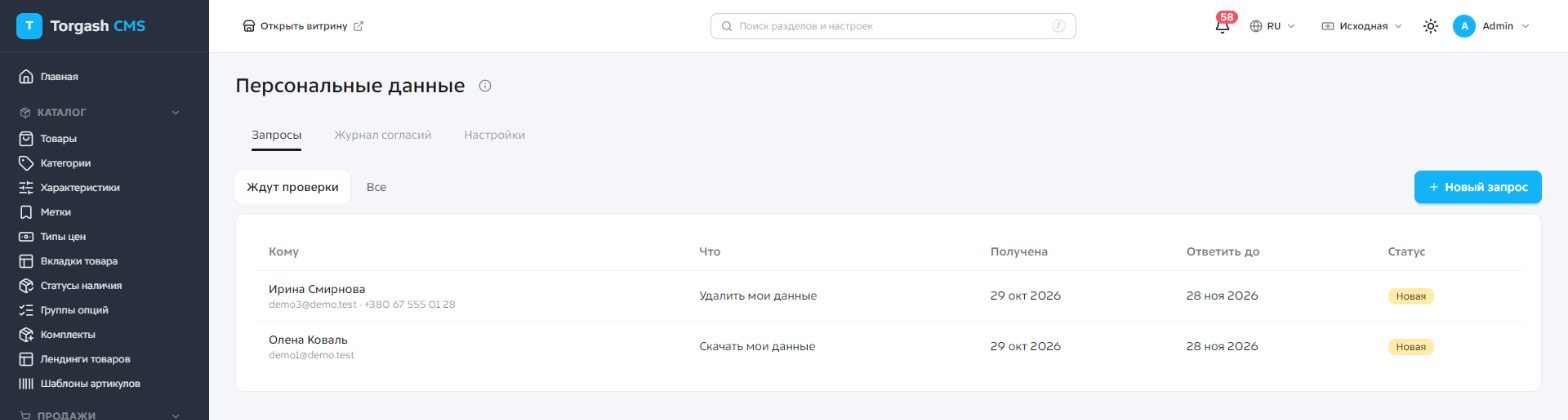
A customer opens My data in their account: they can download everything about their account at once, or ask for it to be erased. A person who wrote or called is entered by hand: New request by email or phone.
The list shows what is asked, when it came in, and the day the law wants an answer by. A request’s screen shows what was found: each module says how many rows it holds for this person by account, email and phone.
- Download the data — one file with everything found.
- Erase — done by a manager, because a person may have an unpaid order or an open return. The account, addresses, wishlist, saved basket and enquiries go; reviews and comments lose the name. Orders stay: the law asks a shop to keep them for its accounts, but without the IP address and browser.
- Refuse — with a reason: an unpaid order, an open return.
What was done is recorded on the request.
How long it is kept
IP addresses in orders, in the audit trail and in the consent log, and verification codes, are cleared every night once older than the days set in the settings. 0 keeps them.
What’s next
- Customer accounts — the ordinary deletion of an account and how it differs.
- Your own forms — the consent box in a form.